
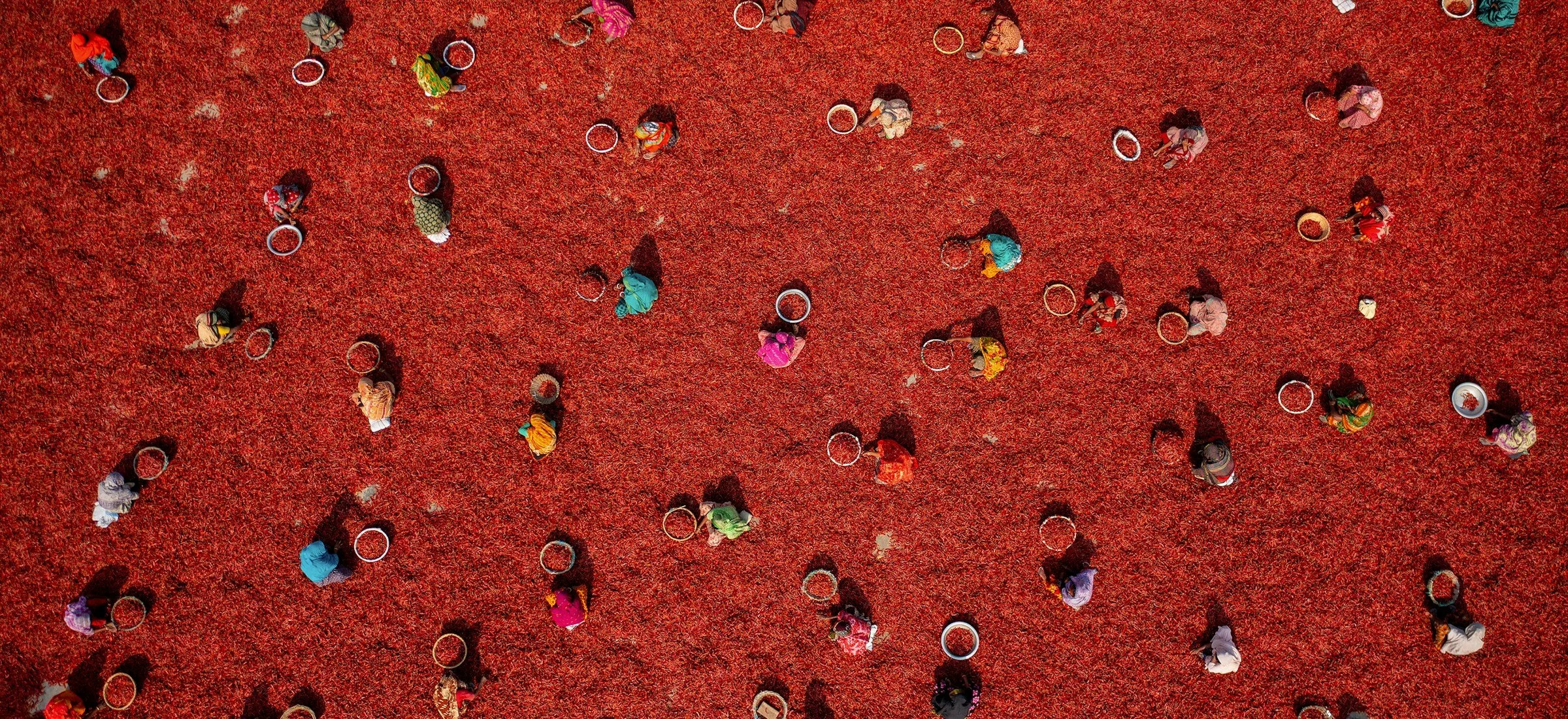
Photo by Azim Khan Ronnie on Unsplash
Geography, empire, and faith put a hundred different dinners on the table. Pretending we all eat the same is the oldest lie in food writing — and we should be done with it.
By the DesiFoodFix Editorial Team
Put two desi strangers at the same table and watch what happens.
One reaches for rice like it's oxygen. The other hasn't touched rice at dinner in their life and wants to know where the roti went. One won't go near the fish. The other thinks fish is basically a vegetable. One orders the beef without blinking. The other just goes very quiet.
We are supposed to be one thing. "Indian food." "Desi food." "Curry." The Western menu took a subcontinent of nearly two billion people and flattened it into a laminated page of chicken tikka masala, garlic naan, and a heat scale that runs from "mild" to "are you sure, sir?"
It was never true. And the differences aren't garnish. They're the whole meal.
Start with the land, because the land started it. There's a line that runs across South Asia that no border patrol enforces but every grandparent knows: the rice line. Below it, and along the wet coasts — the Tamil south, Kerala, Bengal, coastal Karnataka, most of Sri Lanka — rice is dinner, and everything else exists to get more of it into you. Above it, on the wheat plains of Punjab and the Gangetic north, bread is the carbohydrate that matters, torn and folded and used as a tool.
Then there's fat, which tells you where you are faster than a map can. Mustard oil — pungent, sinus-clearing — means you're somewhere in the Bengali-Bihari east. Coconut, in oil and milk and grated flesh, means the south and the Malabar coast. Ghee, rich and gold, is the north flexing. These aren't preferences. They're the taste of whatever the soil and the rain agreed to hand over.
Coast versus interior decides the rest. Where there's water, there's fish — hilsa worshipped in Bengal, kingfish and pomfret along the Konkan, Sri Lankan ambul thiyal gone sour and black with goraka. Move inland and the protein turns to lentil, dairy, and whatever animal could walk itself to market. A Keralan and a Kashmiri are not eating two versions of one cuisine. They're eating two different answers to two different landscapes.
Now the uncomfortable part — the part the nostalgists can't stand. Almost nothing on the "authentic" plate is as old as we pretend.
The chili, the very heat that defines the whole category in the Western imagination, is an immigrant. It arrived on Portuguese ships in the sixteenth century, straight from the Americas. Before that, the subcontinent got its bite from black pepper and long pepper. The fieriest thing your ancestors ate five hundred years ago would taste, to you, faintly polite.
The Portuguese left more than chilies in Goa. Vindaloo isn't a heat dare — it's carne de vinha d'alhos, meat in wine-vinegar and garlic, a Lisbon recipe that learned to speak Konkani. The Mughals brought Persia north and never left: the biryani, the kebab, the korma, the slow magic of dum sealed under a lid of dough. Lucknow's whisper-delicate Awadhi style and Hyderabad's fiercer kachchi biryani are both Mughlai children who grew up in different houses and now refuse to swap recipes.
The British engineered the rest. "Curry powder" is a colonial invention — one jar standing in for a thousand fresh grinds, shipped home so the empire could taste its conquest at the club. They planted Assam and Ceylon with tea and rewrote what an entire region drank before noon.
And then 1947 cut the whole thing in half. Partition was a culinary catastrophe and a culinary engine at the same time. Punjabi refugees carried tandoor and butter and dal across a brand-new border, and that food — by accident of trauma and migration — became the global face of the "Indian" restaurant. The Muhajirs who fled to Karachi brought the courtly cooking of Delhi and Lucknow with them, which is exactly why some of the finest Mughlai food on earth is now, technically, Pakistani.
That's before we even reach the older diaspora — the indentured laborers shipped to Trinidad, Guyana, Fiji, Mauritius, and Natal in the 1800s, whose descendants gave us Trinidadian doubles, Durban's bunny chow, and curries that no longer answer to any Indian state. They are as desi as anyone reading this. They just left a century earlier and built something of their own.
Faith sets the table too, and it never sets it the same way twice.
The myth that India is a vegetarian nation is exactly that — a myth, and a useful one. Most South Asians eat meat. And the vegetarianism that does exist isn't one thing either: a Tamil Brahmin's strict kitchen and a Bengali Brahmin's fish-loving one share a caste and almost nothing else, because in Bengal the fish got quietly reclassified as not-quite-meat generations ago. Jain food runs the opposite direction entirely — no onion, no garlic, nothing dug from the soil — building flavor out of pure restraint.
Islam wrote the north's love of meat into permanence: halal, the Eid feast, the haleem and nihari that anchor the table, the iftar spreads that turn Ramadan dusk into a festival of fried things. Sikhism gave us the langar, the free communal kitchen where a billionaire and a beggar sit on the same floor and eat the same dal — a whole argument about equality served on a steel plate. Kerala's Syrian Christians cook beef and pork with a clear conscience that would scandalize a Gujarati. The Parsis gave us dhansak and the Irani cafe. Every faith drew its own border around the plate.
So no. We don't eat as one people. We never were one people, and the table has always understood that better than the menu did.
This isn't a problem to fix. It's the best thing about us. The diaspora's dinner table is the most honest map of the subcontinent in existence — every dish on it carrying a coast, a conquest, a god, an argument.
The least we can do is stop calling all of it "curry" and start paying attention to what's actually on the plate.